
Oct 22, 2026
Important changes for travellers in 2027
2027 brings a number of important changes for motorists and motorhome owners: Austria is finally phasing out the adhesive vignette, Croatia is introducing a new digital toll system, and in Germany the next deadline for exchanging driving licences is approaching. Rules are also changing regarding the charging of electric cars, vehicle technology and the enforcement of fines within the EU.
We have compiled the most important changes so that you can plan your journeys in good time, avoid unnecessary charges and save time.
Austria: From 2027, the vignette will only be available in digital form
Anyone travelling to Austria by car or motorhome in 2027 will need to be prepared for a change: from the 2027 vignette year onwards, only digital vignettes will be available.
The last adhesive vignette was issued for the year 2026. It remains valid until 31 January 2027. The new 2027 annual vignette, however, will be available from 1 December 2026.
The digital vignette is linked directly to the vehicle registration number, so there is no longer any need to affix a sticker to the windscreen.
Important when buying: Private individuals ordering a digital annual or 2-month vignette directly from the ASFINAG online shop should note that, due to consumer protection regulations, the digital vignette is generally only valid from the 18th day after purchase. The 1-day and 10-day vignettes can, however, be activated immediately.
Our tip: Before you set off, consider which vignette duration suits you best. For a one-off holiday, a 10-day vignette may be better value than an annual vignette.
For motorhomes, it depends on the weight: the vignette requirement generally applies to vehicles with a technically permissible maximum mass of up to and including 3.5 tonnes. Heavier motorhomes over 3.5 tonnes usually require a kilometre-based GO toll. Transitional exemptions apply to certain older vehicles.
Croatia: From spring 2027, the toll system is set to operate without barriers
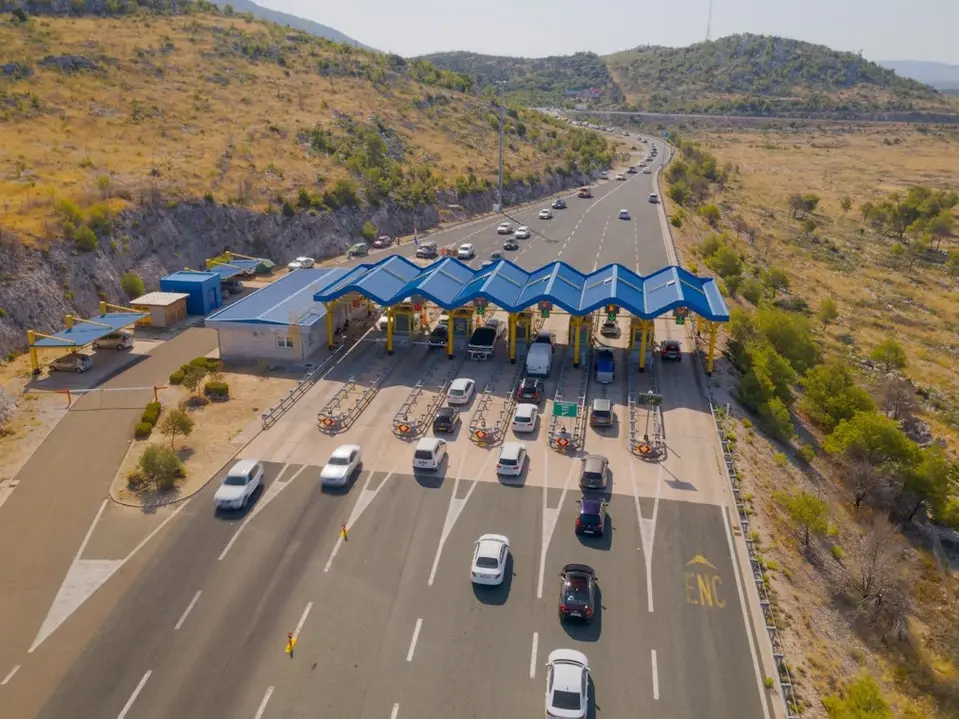
Long queues at Croatian toll stations could soon be a thing of the past for all travellers. The new electronic toll system, Crolibertas, is scheduled to be introduced on 1 March 2027.
Croatia is switching its motorways to the so-called ‘free-flow’ system, whereby tolls are recorded as vehicles pass under toll bridges. It will then no longer be necessary to stop at traditional toll barriers.
The new system offers two options for paying tolls:
Number plate recognition: For vehicles weighing up to 3.5 tonnes, the number plate can be registered in advance using a payment method; cameras then recognise the vehicle on the relevant toll roads.
Electronic toll device (Toll Box): The toll is recorded via a suitable Toll Box fitted to the vehicle. For heavier vehicles with a gross vehicle weight exceeding 3.5 tonnes, this method is mandatory.
For holidaymakers, this makes travelling much easier; particularly during the summer holidays, the stops at toll booths that were previously necessary used to take up a lot of time.
Our tip: Before travelling to Croatia, check which payment system is authorised for your vehicle.
Digital vignette in Belgium
From May 2027, a single digital vignette is to apply to motorways and regional roads in the three regions of Flanders, Wallonia and Brussels; this will be linked to the vehicle registration number and will also be required for foreign cars and light goods vehicles. Journeys on local roads are to be exempt from the vignette requirement. In Flanders, sales are due to begin on 1 March 2027.
Driving bans on Euro 5 diesel vehicles in northern Italy
The introduction of the planned driving bans on Euro 5 diesel vehicles in parts of northern Italy (the regions of Lombardy, Piedmont, Veneto and Emilia-Romagna) has been postponed until October 2027. How the measures will actually be implemented – that is, which towns, vehicles and time periods will be affected – is yet to be set out in regional regulations. This does not entail a blanket driving ban on Euro 5 diesel vehicles.
New traffic regulations in Spain
On 1 October 2027, further regulations in Spain will come into force: motorcyclists will then be subject to a new requirement regarding approved helmets, and the regulations governing the lighting of micro-electric vehicles will also change from that date. Much of the reform, including rules on emergency lanes and the protection of stationary emergency vehicles, has already been in force since October 2026.
Germany: The next deadline for exchanging driving licences is approaching
In 2027, a large number of motorists will once again have to exchange their old driving licences for a new EU card-style driving licence.
By 19 January 2027, it will be the turn of card-style driving licences issued between 2002 and 2004.
The date of issue can be found on the front of the driving licence in field 4a. For people born before 1953, the later exchange deadline of 19 January 2033 applies in all cases, regardless of the year of issue.
Anyone who fails to exchange their driving licence in time must expect to be fined if stopped for a check.
There will also be changes for learner drivers from 1 January 2027: the number of compulsory practical driving lessons will be reduced from 12 to at least 3, the list of theory questions will be cut from 1,169 to 840, and the options for preparing digitally will be improved. This is also intended to make obtaining a driving licence potentially more affordable.

Germany: What will happen to fuel prices in 2027??
CO₂ pricing remains a key issue for petrol and diesel.
The German Government plans to continue keeping the national CO₂ price within a range of between 55 and 65 euros per tonne of CO₂ in 2027. A corresponding amendment to the law was passed by the Bundestag in October 2026.
The new European emissions trading scheme for road transport, ETS2, originally planned for 2027, has been postponed until 2028.
Unfortunately, this does not mean that petrol and diesel will automatically become cheaper again in 2027. The actual price at the pump depends, amongst other things, on the current price of crude oil, taxes and other market conditions.
The German government intends to introduce a fuel price cap by 1 January 2027 at the latest, modelled on the systems in the EU countries of Luxembourg and Belgium. Discussions are still to be held with the oil industry on this matter. However, it has not yet been determined how a price cap would be calculated in detail or what prices would be permitted.
Electric cars: Paying at fast-charging points is set to become easier
Anyone travelling through Europe in an electric car in 2027 will benefit from new European regulations.
From 1 January 2027, publicly accessible fast-charging points with a charging capacity of at least 50 kW along the European TEN-T road network and in certain secure car parks must accept card payments, even if they were installed before April 2024.
Payment must be possible via a card reader or a suitable contactless payment method. This means that users will no longer necessarily need an additional charging card or a contract with a specific provider at the fast-charging points in question.
Furthermore, the European fast-charging network is set to be further expanded by the end of 2027.

New vehicle technology: Euro 7 and automatic emergency call
Additional regulations will also apply to manufacturers of new vehicles in 2027.
€7 from 29 November 2027: The new European emissions standard generally applies to the first registration of new passenger cars and light commercial vehicles. In addition to pollutant emissions, it also takes into account, amongst other things, ultrafine particles and tyre and brake wear.
NG-eCall from 1 January 2027: New vehicles must be fitted with the new generation of the automatic emergency call system, which uses more advanced mobile communications technology and can transmit key information to the emergency services control centre following an accident.
Digital battery passport from 18 February 2027: New electric vehicle batteries placed on the market or put into service in the EU will require a digital battery passport. This contains detailed information on the supply chain, carbon footprint and condition of the battery, which will make it easier to assess its condition and may also be helpful later on when buying a second-hand car.
Re-classifications in motor insurance
The start of 2027 will bring changes to the so-called type class ratings for motor insurance. Around 12.5 million motorists are affected in terms of third-party liability cover. Around 7.4 million policyholders will be subject to higher ratings, whilst 5.1 million will be assigned better type classes. For almost 30 million insurance customers, the rating will remain unchanged.
Regional classes will also change in 2027. For around 5.2 million motorists, this will result in a better – and therefore cheaper – classification for third-party liability cover, whilst 4.8 million will be classified in a higher – and therefore more expensive – category across 46 registration districts. Nothing will change for more than 32 million policyholders.

Be aware of fines in the EU in 2027!
Traffic offences committed in other EU countries that result in a fine have been enforceable in Germany for some time now. However, cooperation between authorities across the EU is set to be further expanded in 2027. This will make it easier for foreign authorities to access vehicle owner data and to prosecute more offences across borders.
In addition to exceeding the speed limit, this change will apply to offences such as running a red light, driving under the influence of alcohol or drugs, using a mobile phone whilst driving, failing to maintain a safe following distance, driving without a seatbelt or helmet, endangering others, and hit-and-run offences.
In future, penalty notices must be issued in the language of the country in which the vehicle is registered, or in an official EU language of the person’s choice. The legal basis for this is Directive (EU) 2024/3237.
For holidaymakers and commuters, this means that anyone who receives a fine notice from abroad should check its authenticity, the registration number, the deadline, the amount and the competent authority..
Motorhomes: Will the new 4.25-tonne limit come into force as early as 2027??
The new EU Driving Licence Directive provides that, under certain conditions, motorhomes with a maximum authorised mass of up to 4.25 tonnes may also be driven in future.
Member States must transpose the provisions into national law by 26 November 2028; the new rules are then due to come into force on 26 November 2029. Additional training or changes to the driving tests may be required.
So no, nothing will change here for Category B driving licences next year..
Travel more easily through Europe with the maut1.de Toll Box
Regardless of any changes to the law, you can already save time at many European toll stations today.
With a suitable maut1 Toll Box, you can use the dedicated toll lanes in countries such as Italy, France, Spain and Portugal. The tolls are recorded automatically and conveniently billed via your maut1.de customer account.
This offers several advantages:
Less or no waiting time at toll stations thanks to reserved lanes.
No need to search for cash or a credit card at the barrier.
Automatic recording of toll charges on supported routes.
A central overview of toll journeys that have been billed.
This is particularly handy in France, where several motorway sections have already switched to the barrier-free free-flow toll system. Without automatic payment, however, you must ensure that any toll charges incurred are paid within 72 hours of the journey.
The specific Toll Box you need depends, amongst other things, on your vehicle’s height, weight and destination.
We have provided further information on popular holiday destinations here:

Conclusion: Well prepared for the 2027 holiday
The most significant changes in 2027 mainly concern digital tolls, driving licence conversion and new requirements for vehicles and charging infrastructure.
If you are familiar with the rules in your destination country, you can avoid unnecessary costs and plan your journey with greater peace of mind.
With the right maut1.de Toll Box, you can also avoid having to stop to pay on many toll roads.
Find out more before your next trip and find the right Toll Box at www.maut1.de.