
Order your maut1.de toll box now!

The PREMIUM toll box for cars and vehicles up to 3 metres in height is available for the following countries:




Italy, Portugal, France, Spain, Croatia (excluding Istria)

Standard toll box for cars and vehicles
up to 3 metres in height is available for the following countries:
Italy (excluding Sicily), Portugal, France, Spain

Toll box for motorhomes and vehicles over 3 metres in height is available for the following countries:

Italy, Portugal, France, Spain, Austria
Drive through France uncomplicated in just 4 steps with our toll box.


Installing the toll device
Mount the toll device next to the rear-view mirror on your windscreen. The toll box is ready for use immediately!
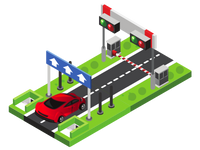
Enjoy a free ride
Use lanes marked with a "t". You don't have to draw a ticket, but can drive contactless through the toll booths.
Invoice by e-mail
We debit the toll charges each month from your lodged payment method. You will receive an overview of the tolls charged by e-mail.
How the toll works in France?
France relies on a distance-based toll system that works on the principle of "drive on - take a ticket - pay - drive off". When you enter the motorway, you take a ticket. When you leave the motorway, you pay the toll, which is based on the distance travelled. Alternatively, there are some sections and special structures (e.g. tunnels or large bridges) on which a flat-rate fee is payable, regardless of the distance travelled.
- Almost all French motorways are subject to tolls.
- On average, you can expect to pay a toll of just under 10 cents per kilometre in France (as of 2025), although significantly more expensive routes can cost up to 21 euros per 100 kilometres.
- No toll is payable on rural roads.
- Tolls are also charged for tunnels and bridges.
Tolling systems: Closed, Open, Free-Flow
| Closed system: | When entering the motorway without a toll box, a ticket must be taken, which must be paid on the spot when leaving the motorway without a toll box, depending on the distance travelled. |
|---|---|
| Open system: | On some sections, a flat-rate fee is charged regardless of the distance travelled. |
| Free-Flow ("Péage en flux libre"): | Motorways are increasingly being converted to a pure camera system without barrier toll stations, in which only the number plate on the vehicle is optically recorded, the Free-Flow toll. These roads, which are marked with "Péage en flux libre" signs, are also covered by the toll box. |
☛ In the lane labelled "t" or "telepéage", you can pass through the stations without long waiting times using only a toll box and without paying on the spot.
City tolls in France
In France, there are so-called "environmental zones" in several cities such as Paris, Lyon and Marseille, in which the Crit'Air environmental badge is required for a fee. If certain concentrations of air pollutants are exceeded, these are occasionally only temporarily cancelled.
☛ The Crit'Air is comparable to the German "environmental badge" and is not covered by the toll box.
Vehicle classes for tolls in France
Amount of motorway toll by vehicle class
The amount of the toll to be paid in France is based on the actual data that the vehicle or vehicle combination has during the journey through the toll station.
The vehicle class, which is determined automatically at the toll station in France, is based on:
- vehicle height, measured without superstructures at the front of the vehicle,
- actual weightand
- number of axles
and is categorised as follows:





Toll costs for popular routes (as of May 2025)
Note: The toll costs given are approximate and may vary depending on the route or last-minute changes and are therefore not guaranteed. An exact calculation is unfortunately not possible in advance. The prices quoted refer exclusively to vehicle classes 1 and 2.
| Route | Toll charge |
|---|---|
| A1, A26: Paris – Calais Nord | 24,70 EUR |
| A1: Paris – Lille Nord | 19,00 EUR |
| A4: Paris – Straßburg Bas-Rhin | 43,70 EUR |
| A6, A7: Paris – Marseille Bouches-du | 68,10 EUR |
| A6: Paris – Lyon Rhône | 42,40 EUR |
| A6, A7, A36: Straßburg – Montpellier Herault | 66,80 EUR |
| A10: Paris – Bordeaux, Gironde | 61,00 EUR |
| A26: Troyes – Calais Nord | 40,20 EUR |
| A40: Macon – Mont-Blanc | 80,60 EUR |
| A63: Bordeaux – Bayonne | 13,40 EUR |
| Tunnel / Bridge | Motorcycles | Passenger cars up to 3.5 tonnes | Further information |
|---|---|---|---|
| Duplex A86 | from 7,00 to 14,00 EUR | from 7,00 to 14,00 EUR | Tunnel Duplex |
| Mont-Blanc-Tunnel (FR/IT) – one way trip | 35,80 EUR | 54,10 EUR | Mont Blanc-Tunnel |
| Mont-Blanc-Tunnel (FR/IT) – Outward and return journey | 45,00 EUR | 67,50 EUR | Mont Blanc-Tunnel |
| Périphérique Nord Lyon | 2,50 EUR | 3,80 EUR | Tunnel de Caluire |
| Tunnel de Puymorens | 4,60 EUR | 7,60 EUR | Vinci Autoroutes |
| Tunnel du Fréjus (IT/FR) – one way trip | 35,80 EUR | 54,10 EUR | Fréjus-Tunnel |
| Tunnel du Fréjus (IT/FR) – Outward and return journey | 45,00 EUR | 67,50 EUR | Fréjus-Tunnel |
| Tunnel Maurice-Lemaire | 6,60 EUR | 10,30 EUR | |
| Tunnel Prado Carénage | 3,20 EUR | 3,20 EUR | Tunnel Prado |
| Tunnel Prado Sud | 2,70 EUR | 2,70 EUR | Tunnel Prado |
| Pont de Normandie | 0,00 EUR | 5,90 EUR | Pont de Normandie |
| Pont de Tancarville | 0,00 EUR | 2,80 EUR | Pont de Tancarville |
| Viadukt Millau from 15.6. to 15.9 | 5,70 EUR | 11,70 EUR | Viaduc de Millau |
| Viadukt Millau from 16.9. to 14.6 | 5,70 EUR | 9,50 EUR | Viaduc de Millau |
Additional toll charges in France
| Bridge | Connection | Toll (car) |
|---|---|---|
| Pont de Normandie | Le Havre – Honfleur | 5,90 EUR |
| Pont de Tancarville | Tancarville – südlich von Le Havre | 2,80 EUR |
| Pont de Saint-Nazaire | Saint-Nazaire – Trignac (Loire-Atlantique) | 2,80 EUR |
| Pont de l'île de Ré | La Rochelle – Insel Ré | 16,00 EUR |
| Pont de la Caille | Nähe von Annecy, Haute-Savoie | 4,00 EUR |
| Pont de Millau | Millau – A75 | 9,50 EUR – 11,70 EUR (depending on the season) |
| Pont de la Baie de Bourgneuf | Saint-Philbert-de-Grand-Lieu – Île de Noirmoutier | 2,90 EUR |
| Pont de Saint-Étienne-du-Rouvray | Near Rouen | 2,50 EUR |
| Pont de l'île de Noirmoutier | Island Noirmoutier – Mainland | 5,00 EUR |
| Pont de la Loire | Nantes – Île de Nantes | 2,00 EUR |
☛ There are toll calculators for France on the Internet that allow you to easily calculate the toll costs you are likely to incur before travelling. For example, this function is offered by the ADAC.
FAQ about toll roads in France
Do I have to pay tolls on all motorways in France?
No, tolls are charged on most French motorways. Exceptions include feeder roads and certain sections in the regions of Alsace, Lorraine, Auvergne and Brittany. Some city motorways and bypasses - for example around Paris, Lyon, Bordeaux, Toulouse and Marseille - are also toll-free.
How much toll do I have to pay in France?
The tolls average around 10 cents per kilometre (as of 2025). On some routes, the costs can be significantly higher - up to 21 euros per 100 kilometres.
How can I pay at the toll stations?
France distinguishes between two systems:
Closed system: Ticket on entry, payment on exit - depending on the distance travelled.
Open system: Flat-rate fee at individual toll stations - regardless of the distance travelled.
Payment options at the toll lanes:
Green arrow: For all vehicle categories.
"cb" lanes: Card payment only (credit card).
"t" lane: For vehicles with a toll box (e.g. from maut1.de) - automatic recording without stopping.
What toll collection systems are there in France?
France uses three toll systems:
Closed: Ticket collection and payment according to the number of kilometres driven.
Open: Flat-rate charge on certain routes - often in cities.
FreeFlow: barrier-free driving under toll bridges. The licence plate number is recorded and the charge is billed digitally.
→ Without a toll box, payment must be made online or at terminals within 72 hours.
Exemplary FreeFlow routes:
A79 (Montmarault - Digoin)
A4 (Paris - Strasbourg), exit Boulay
What happens if you don't pay the toll?
- After missing the deadline: fine of 10 euros
- In case of further non-payment: increase to 90 euros
- After 2 months: up to 375 euros fine in addition to the toll
What do you need to know about low emission zones in France?
France is increasingly establishing environmental zones – including on motorways and in tunnels (e.g. the A35 near Strasbourg and the Fourvière Tunnel near Lyon).
This requires the Crit'Air vignette, which is available in six different colours and is graded according to emission classes – including for foreign vehicles. The German environmental sticker is not recognised.
Online ordering: www.certificat-air.gouv.fr
Permanent low emission zones (ZFE-m) currently exist in:
- Paris & surrounding area, Grenoble, Lille, Lyon, Marseille, Montpellier, Nantes, Nice, Reims, Rennes, Rouen, Strasbour, Toulouse, Aix-Marseille, Angers, Annecy, Annemasse, Bordeaux, Brest, Caen, Clermont Auvergne, Le Havre, Nîmes, Pau, Pays-Basque, Saint-Etienne, Savoie und Tours.
- Other cities e.g. Metz and Mulhouse in France are set to follow.
How can I pay the toll in France if I don't have a toll box?
Without a toll box, you take a ticket when you enter the motorway, which you pay when you exit. On some sections of the motorway, a flat rate is payable directly at the toll station - no ticket is required there.
How is the toll calculated in France?
The toll in France is charged according to distance travelled and vehicle class, which are divided as follows in France:
- Class 1: Vehicles up to 3.5 tonnes, up to 2 metres in height
- Class 2: Vehicles up to 4.5 tonnes, between 2 - 3 metres in height
- Class 3: Vehicles over 3.05 metres in height or more than 4.5 tonnes
- Class 4: Vehicles with 3 or more axles
- Class 5: Motorcycles and trikes.
How does the electronic toll work in France?
All lanes in France with a "t" can be used with our toll box for automatic toll collection. With the toll box from maut1.de, you don't have to take a ticket, but can drive through the toll station without contact. This saves you time and hassle when collecting tickets.
How does the Flux-libre / Free-Flow toll road system work in France?
So-called free-flow toll roads in France (also known as ‘Péage en flux libre’) are essentially barrier-free systems where it is no longer possible to stop and pay on site. Here, the vehicle's registration number is automatically recorded by camera and the corresponding fees are billed electronically.
Free-flow tolls are already in use on some sections of the following motorways:
- A4: between Saarbrücken and Metz (exit no. 36 Boulay-Moselle)
- A13/14: between Paris and Caen
- A79: between Montmarault - Digoin
Other planned sections are:
- A40: Chamonix - Geneva on 50 km between the Annemasse and Passy junctions
- A69: 53 km between Castres - Toulouse
- Junction ramps on the A41, A48 and A49 (Lyoun and Grenoble)
All motorists without a toll box have only 72 hours after driving on a free-flow toll road to pay the toll (online or at special terminals at rest stops along the way).
The toll box from maut1.de also covers free-flow toll systems in France, so you can travel in comfort, as you are automatically registered with your licence plate number.
How do I pay for the free-flow toll (Péage en flux libre) in France?
In France, motorists have only 72 hours to pay the toll for their journey after passing through free-flow toll stations. There are several options for doing so:
- Toll box (‘badge de télépéage’): If the vehicle is equipped with a toll box, e.g. from maut1.de, the toll box is recorded by the toll bridges each time it passes through and the payment is debited automatically and conveniently via the stored payment method.
- Registration: For the A79 motorway, you can register in advance with Aliae and for the A790 motorway with Sanef. After entering your licence plate number and bank details, the fees are then automatically deducted each time you travel.
- Online payment: After your journey, you can pay on the motorway operator's website by searching for your registration number: e.g. via ALIAE or Sanef or the Nirio network.
- Payment on site: Along routes with free-flow tolls, machines for payment by cash or credit card are available at service stations, tobacconists or toll booths.
Do I have to pay attention to special traffic rules in France?
In France, some traffic rules are different to those in Germany. So that you can enjoy a carefree holiday, we have compiled the most important information on traffic rules, penalties and fines in France for you in our blog.

You still have questions?
You can find answers in our general FAQ or you are welcome to contact us.
Further tips and advice from the maut1.de team as well as additional travel information for your next holiday can be found in the maut1.de blog.
Header image ©AA+W - stock.adobe.com